Dangerous goods

In consultation with Transport Canada and industry experts, we have updated our policy on the safe transport of immobile electric vehicles (EVs) which will come into effect on May 19th. These changes reflect the latest safety guidance and eligibility criteria.
Declaring dangerous goods
Non-commercial carriers
- BC Ferries baggage vans will not carry dangerous goods of any kind
- Dangerous goods are prohibited as foot passenger hand baggage
- Some camping fuels are prohibited, for example Butane (UN1011). See our common prohibited items list, or reach out to your terminal of departure prior to travel for more details
By online booking
Select the "Carrying dangerous goods" checkbox after entering the vehicle information.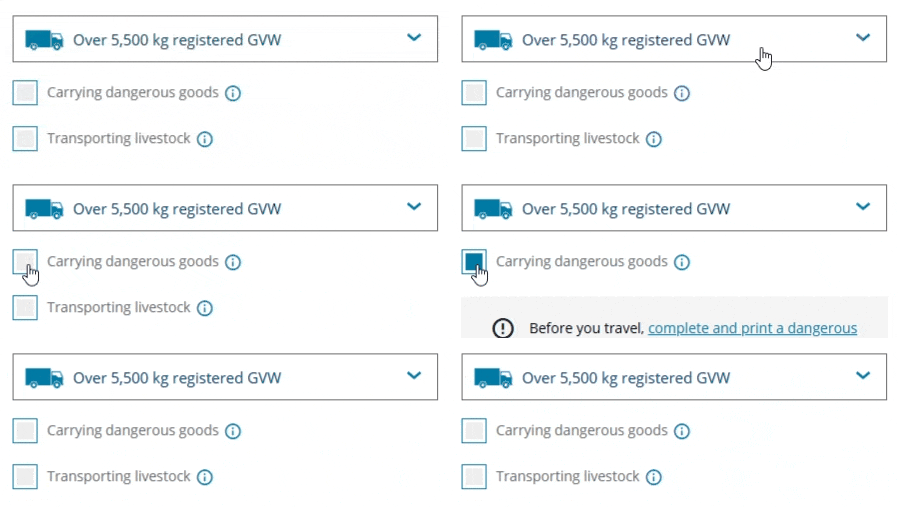
Without a booking, or travelling on a non-bookable route
Declare all dangerous goods upon arrival at the terminal:
- To the ticket agent in the ticket booth, prior to purchasing a ticket
- To the terminal attendant, if there is no ticket booth
- To the vessel officer prior to departure, at unstaffed terminals
Prince Rupert sailings:
For dangerous goods cargo sailings and dangerous goods being transported in and out of Prince Rupert:
- Fax a completed dangerous goods pre-clearance fax cover along with a completed dangerous goods shipping document to your departure terminal at least 48 hours before travel.
- Apply for a dangerous goods permit from the Prince Rupert Port Authority at least 24 hours before your scheduled sailing.
- Please have a completed BC Ferries dangerous goods shipping document to provide to the ticket agent when you arrive at the Prince Rupert terminal
- The Prince Rupert Port Authority is closed on weekends and will not be able to issue permits until the following Monday
1. A completed shipping document
If you don't have a completed shipping document already, you can download one here. Print your completed document and present it to the ticket agent when you arrive at the terminal.
2. A dangerous goods driver certificate
All drivers transporting dangerous goods must be properly trained, and carry a valid certificate issued by their employer.
3. Vehicle safety markings
All vehicles transporting dangerous goods must have the appropriate safety markings clearly indicated.
Check-in times
Check-in times vary depending on terminal, but typically are 30 to 45 minutes before their scheduled departure time.
In order to prevent delays, drivers must:
- Arrive with their vehicle at the terminal
- Declare their dangerous goods
- Provide a completed dangerous goods shipping document
Check-in 45 minutes prior to sailing time at the following terminals:
- Victoria (Swartz Bay)
- Vancouver (Tsawwassen)
- Vancouver (Horseshoe Bay)
- Nanaimo (Departure Bay)
- Nanaimo (Duke Point)
- Sunshine Coast (Langdale)
For all other terminals, check-in 30 minutes prior to sailing time.
Damaged electric vehicles
Damaged or defective electric vehicles (EVs) are not permitted. The EV is considered damaged or defective if:- The battery casing is cracked, punctured, or visibly damaged
- Leaking coolant or unknown fluids from the battery area
- Smoke, vapour, or heat coming from the battery
- Exposed or frayed high-voltage wiring
- White powder residue near battery components
- Any signs of fire damage or unusual odours
Transporting immobile EVs
Fireworks
Fireworks are prohibited on BC Ferries.
BC Ferries generally prohibits the carriage of all explosives on regular passenger sailings, except for Class 1.4S, and certain explosives when used in life-saving equipment.
Butane
Some camping fuels like Butane (UN1011) are prohibited.
Passenger vehicles are permitted to carry some camp fuels, such as a maximum of 5L in metal containers of Coleman's Fuel (aka naptha, or white gas), however, at no time are foot passengers permitted to use the baggage service while carrying dangerous goods.
Please see the common dangerous goods list below for information regarding other camping fuels.
Common dangerous goods
These are some commonly transported dangerous goods items that may require a completed dangerous goods shipping document. This includes all gas or propane tanks, outboard motors with attached tanks, chainsaws, scuba tanks and more.If no other camping fuels or propane are carried, customers can carry up to three (3) 1L containers of gaseous camping fuel (for example: UN1978, UN2037, UN1075, UN1268, and UN1950), or up to one (1) 5L container of liquid camp stove fuel without requiring dangerous goods documentation.
Camping fuels are not permitted on Passenger decks. Foot passengers must assume responsibility for the handling and supervision of their camping fuel and remain with it for the duration of the voyage as follows:
- For major and large vessels equipped with two vehicle decks, foot passengers must remain with their dangerous goods on the upper (open) of the two decks, namely the upper vehicle deck.
- For minor and intermediate-sized vessels equipped with only one vehicle deck, foot passengers must remain with their dangerous goods on that vehicle deck, as it is considered the open vehicle deck.
- Foot passengers carrying camping fuels who wish to travel on North Coast routes, please reach out to the Dangerous Goods office for more information by filling out this contact form.
All containers of dangerous goods are treated as full, regardless if they have some or none of the product inside.
New containers are permitted without shipping documents if they have never previously held dangerous goods. Empty containers are permitted without shipping documents only if they have been cleaned and purged and the carrier presents a purge certificate.
Gasoline
Gasoline must be in approved containers (e.g. CSA-approved jerrycans). Your vehicle’s fuel tank must contain the same type of fuel you are carrying.
Personal vehicles are permitted:- 1 approved 25 litre container or jerrycan of gasoline properly secured within the vehicle. The container is considered a dangerous good if it contains any amount of gasoline, including only gasoline fumes.*
- 2 additional approved 25 litre containers or jerrycans of gasoline secured in the trailer.
There are no other amounts of gasoline allowed on a passenger vessel. This includes gasoline in tidy tanks.
* Gasoline carried in portable containers in quantities exceeding the amounts listed above must be filled to the brim with water in order to no longer qualify as dangerous goods.
Foot passengers are not allowed to carry gasoline on board.
Oxygen
- Personal use oxygen cylinders may not exceed 5L water capacity.
- Cylinders that are not in a portable unit must be secured within the transport vehicle.
- The transfer of liquid oxygen from the “liberator” or bulk container to the “stroller” or portable container, on board the vessel, is prohibited.
Propane
- Up to two (2) cylinders with a combined capacity not exceeding 65L, and each cylinder individually must not exceed 46L.
- One (1) cylinder with a capacity not exceeding 18.9L; or
- If no other propane is carried, the limit is three (3) cylinders with a capacity not exceeding 1L water capacity.
All propane tanks must be closed and tagged prior to boarding. Cylinders must be upright and securely attached to the vehicle.
If no other camping fuels or propane are carried, customers can carry up to three (3) 1L propane cylinders, without dangerous goods paperwork.
Propane is not permitted on Passenger decks. Foot passengers must assume responsibility for the handling and supervision of their camping fuel and remain with it for the duration of the voyage as follows:
- For major and large vessels equipped with two vehicle decks, foot passengers must remain with their dangerous goods on the upper (open) of the two decks, namely the upper vehicle deck.
- For minor and intermediate-sized vessels equipped with only one vehicle deck, foot passengers must remain with their dangerous goods on that vehicle deck, as it is considered the open vehicle deck.
- Foot passengers carrying camping fuels who wish to travel on North Coast routes, please reach out to the Dangerous Goods office for more information by filling out this contact form.
- Dangerous goods shipping document required. All relevant dangerous goods information i.e. UN number, shipping name, etc. must be included
- Partial or full tanks are to be transported in closed, locked vehicles, or in open vehicles, provided the tanks are out of sight.
- Empty SCUBA tanks with valves fully opened and not containing any compressed air or under pressure are not considered dangerous goods.
- Foot passengers may take these tanks aboard, provided the tanks are NOT taken into passenger areas but taken immediately to the main vehicle deck for stowage during the voyage.
- The vessel's officer will identify a safe stowage area on the vessel
- These tanks are not considered as baggage and our employees are not permitted to handle them or to transport them in our baggage vans.
Wheelchairs (motorized)
Wheelchairs have no restrictions when they are in use, but there are some precautions when they are carried as cargo or freight:
- The battery must be securely in place, disconnected, with the terminals insulated to prevent short-circuiting.
- The chair itself must be securely anchored so that it will not move.
Dangerous goods classes and examples
The list below classifies some commonly encountered dangerous goods that may require a completed dangerous goods shipping document, but it is not an exhaustive list.
Please check if what you are transporting is allowed prior to travel. If you’re not sure if the items you intend to bring are dangerous goods, you should:
- Verify with the manufacturer or supplier, or
- Contact the Canadian Transport Emergency Centre (CANUTEC) by phone at 1‑613‑992‑4624, or
- Visit the Transportation of Dangerous Goods Program website
 Class 1 – Explosives
- Ammunition and cartridges
- Foot passengers are not allowed to transport firearms and ammunition unless they are travelling between Port Hardy to/from Prince Rupert, and Prince Rupert to/from Skidegate. For those routes, ammunition must be contained in a separate locked case from the firearm, identified with the name of the customer.
- For more information about our firearm transportation policy, refer to Section 13: Transportation of firearms in our Rules and Regulations.
- Black powder
- Blasting caps
- Detonators
- Dynamite
- Explosive fuses and igniters
- Fireworks
- Prohibited on BC Ferries
- Flash powder
- Grenades
- Rocket motors
- Signal flares
- Some pyrotechnics are permitted if they are used as safety equipment for a vehicle. These pyrotechnics will fall under the category of Class 1.4s.
- Toy and starting pistol caps
 Class 2 – Compressed gases
- Aerosol products (hair sprays, inhalers)
- Bear and dog spray
- Camping stove and BBQ cylinders
- Camp fuels (i.e. UN 2037: small receptacles containing gas)
- Cryogenic liquids (nitrogen, helium, etc.)
- Cylinders of compressed gas (oxygen, air, acetylene, carbon dioxide, etc.)
- Fire extinguishers (must be securely affixed to the vehicle)
- A shipment of fire extinguishers requires a shipping document.
- Medical oxygen for personal medical use
- Propane
- does not require dangerous goods documentation if within the prescribed limit
 Class 3 – Flammable liquids
- Adhesives (glues)
- Alcohols (butanol, methanol, ethanol etc.)
- Camping fuel
- Cigarette lighter fuel
- Furniture stripper
- Gasoline
- does not require dangerous goods documentation if within the prescribed limit of 1 approved 25 litre can, or 2 additional approved 25 litre cans if vehicle is towing a motorboat, up to 2 ATVs, snowmobile, motorbikes or personal watercraft in a trailer.
- Petroleum products and kerosene
- Paint and related products, including lacquer, enamel, stain, shellac, varnish, polish, liquid filler and liquid lacquer base
- Thinners
 Class 4 – Flammable substances
- Charcoal
- Fire starters
- Flameless Ration Heaters (FRHs)
- Fuel tablets
- Hay bales
- Must be secured within a closed vehicle, or the load must be completely tarped/covered to prevent random ignition. Class 4.1 placarding must be displayed when transporting over 500kg.
- Metals (calcium, magnesium, phosphorous, and sodium)
- Oil impregnated fabrics
 Class 5 – Oxidizers and organic peroxides
- Ammonium nitrate products (fertilizer)
- Bleaching powders
- Fibreglass repair kits
- Hair and textile dyes
- Hydrogen peroxide
- Nitrates
- Organic peroxides
- Oxygen pellets
- Pool chlorine and bromine
 Class 6 – Toxic and infectious substances
- Arsenic
- Bacteria and viruses (hepatitis, HIV, etc.)
- Chloroform
- Disinfectants
- Drugs and medicine
- Fungicides
- Herbicides
- Infectious diagnostic specimens (blood samples)
- Used needles and swab
 Class 7 – Radioactive materials
- Some medical and industrial equipment (e.g., X-ray machinery, density gauges, smoke detectors)
- Medical isotopes
- Smoke detectors
 Class 8 – Corrosives
- Acids (hydrochloric, sulphuric, nitric, muriatic, etc.)
- Automotive batteries (in addition to the battery needed for the operation of a vehicle)
- Battery acid
- Caustic soda
- Cleaners (example: bleach, oven cleaners, etc.)
- Drain openers
- Dyes
- Etching fluid
- Formaldehyde
- Household bleaches
- Mercury
- Mercury thermometers and blood pressure gauges
- Paint or varnish remover
- Potassium hydroxide
- Rust removers
- Self Heating Beverages (SHBs)
- Soda lime
- Sodium hydroxide
 Class 9 - Miscellaneous
- Air bags
- Asbestos
- Carbon dioxide solids
- Dry ice
- Gas filled shock absorbers
- Lithium batteries (with or without device)
- Engine, internal combustion, flammable liquid powered devices (e.g. generators)
- Self-inflating lifesaving appliances
- Strong magnets
Additional resources